

How to Become a Chauffeur in London: Complete Legal, Licensing, and Professional Framework
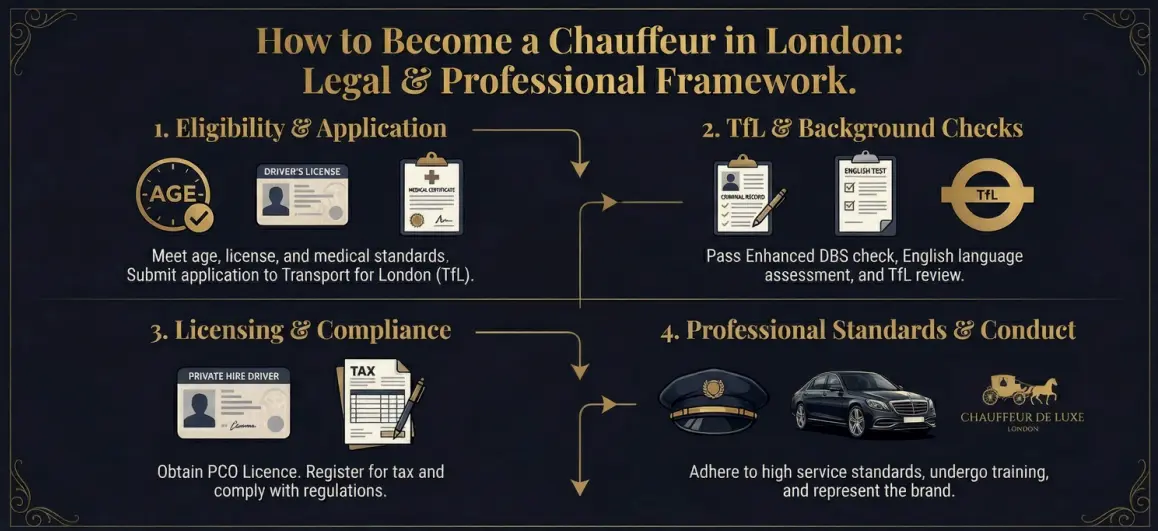
The process of becoming a chauffeur is a professionally regulated path in London. It includes statutory licensing requirements, medical fitness standards and criminal background checks, English language assessment, and compliance rules. Transport for London administers the process, which applies to anyone who wants to be a chauffeur or private hire driver in Greater London.
This guide provides a comprehensive overview of the legal and professional requirements to become a chauffeur in London. It covers everything from licensing and assessments to tax compliance and post-licensing duties.
Legal Framework and Regulatory Authorities
Public Carriage Office and Transport for London
The Public Carriage Office is responsible for licensing chauffeurs and private hire drivers in London. The PCO is part of Surface Transport within Transport for London (TFL).
TfL, the Mayor's Transport Strategy, is implemented by TfL. TfL also manages all transport services in Greater London. The PCO is responsible for licensing:
- Private hire drivers
- Private Hire Vehicles
- Private hire operators licensed.
Private Hire Vehicles Act (London) 1998
The Private Hire Vehicles (London) Act 1998 extended the PCO's power to regulate formal private hire services. This Act:
- All chauffeur work has to be booked in advance through a licensed private hire company.
- Drivers can work anywhere in London as long as bookings are only accepted through licensed operators.
- Private hire drivers are not allowed to street hail.
TfL must issue a licence to all applicants who meet the statutory requirements.
Private Hire Driver Licence (PCO Licence)
Licence Requirement
You must have a private hire driver licence to work as a chauffeur. This is also known as a PCO licence. This licence is compulsory and applies whether you're employed by a business or self-employed.
Eligibility Criteria
For a private hire driver licence to be granted, the applicant must meet each of the following requirements.
- Age must be at least 21 at the time of applying.
- Have a full DVLA licence (UK or Northern Ireland) for a period of at least three years
- You must have the right to work and live in the UK.
- Meet good character requirements
- Medical standards for DVLA Group 2.
- Completing all assessments
- Fill out an HMRC tax return
If all the criteria are met, there is no upper limit to age.
Check your criminal and character history
#### DBS Enhanced Check
TfL asks all applicants to prove that they have good character. The enhanced Disclosure and Barring Service check is conducted by TfL's authorised service provider.
The DBS subscription service allows for certificates to remain current and be reused in future renewals or licensing.
If you do not meet the character requirements, your licence may be refused or revoked.
English Language and Regulatory Assessments
SERU Assessment
The Safety, Equality and Regulatory Understanding Assessment (SERU) evaluates:
- English reading and writing skills
- Safety responsibilities and their understanding
- Know the law on equality
- Private hire regulations: What you need to know
This test ensures that drivers understand written instructions, signs, and legal requirements.
Assessing Speaking and Listening
To evaluate verbal communication in English, a separate speaking and listening test is required. This assessment will be conducted by secure video or telephone link on TfL premises.
The English language requirement must be met by passing both assessments.
Medical Fitness Requirements
Group 2 Medical Standards
Private hire drivers are required to meet DVLA Group 2 medical standards. These are the same as those for:
- Drivers of large goods vehicles (LGVs)
- Bus and coach drivers
The applicant must have a full medical history reviewed by a doctor. Applicants with certain medical conditions, including vision impairments, may be refused.
TfL recommends that applicants consult their doctor before applying if they have any questions about medical eligibility.
Topographical Skill Assessment
Private hire drivers do not have to pass the "Knowledge" test like taxi drivers. They must, however, demonstrate practical map-reading and route-finding skills.
Test your skills
The topographical skill assessment assesses:
- Use of grid references and indexes for map reading
- Planning a local route within a selected London area
- Planning your route through London
- Planning long-distance routes to destinations outside London
- Geographical awareness includes:
○ Major arterial roads
○ Airports
○ Other towns and cities than London
The licence won't be issued without adequate topographical knowledge.
Exemptions
The following applicants may be exempt:
- Formerly licensed PHV driver who has passed the TfL topographical exam
- All London taxi drivers are licensed (suburban or London).
- Professional London Tourist Guides (Blue Badge).
From 1 February 2020, the exemptions based upon vocational qualifications will be removed.
HMRC Tax Check Required
Before a licence or renewal can be issued, all applicants must complete an HMRC tax check.
This process requires that:
- The GOV.UK Government Gateway ID
- Registration for Tax Purposes
- Generating a nine-character tax code
As part of the licensing procedure, TfL must receive the tax check code.
Application Process
You can submit your application by:
- Registration online via TfL's licensing platform is possible.
- TfL: Requesting a paper pack
The Living and Working Abroad Form is required for applicants who have worked or lived abroad for at least three months.
TfL's photo guidelines require that you submit a passport-style image.
Licensing costs
The following are typical application costs:
- DBS Disclosure Application (online or on paper)
- Application fee for a licence (non-refundable).
- Grant of Licence Fee
- Assessment fee for speaking and listening
- Assessment fee for SERU
- Topographical Assessment Fee
- Medical examination fees (determined by the GP).
The total costs can vary, but they represent an important upfront investment.
After Obtaining Your Licence
Once licensed, drivers can only accept bookings from PCO-licensed private rental operators.
You can choose between:
- Use the fleet vehicle of a licensed driver,
- Own and operate their own TfL-licensed vehicle
Ownership of a vehicle provides greater flexibility and income opportunities but also requires a higher level of capital and compliance responsibility.
Professional Chauffeur Standards & Employer Expectations
Professional chauffeur employers usually require that drivers have a valid PCO licence.
- The vehicle must be less than three years old to be eligible for TfL licensing.
- Valid MOT (where applicable).
- Private hire insurance
- Character references
- Chauffeur experience
- Business attire
- Signing confidentiality agreements
- Internal Driving Assessments
- Evaluation of topography and etiquette
- Security awareness and discretion
- Experience in customer service or hospitality
- First aid knowledge
- Flexibility and punctuality
- Geographical knowledge
Some employers conduct ongoing performance evaluations and monitored test drives.
Approved Chauffeur Fleet
The following vehicles are used by our chauffeur services:
- Mercedes V-Class
- BMW 7 Series
- Mercedes S-Class
- Range Rover
All vehicles must meet TfL's licensing, safety and compliance standards.
Earnings and Career Progress
The earnings of a chauffeur in London can vary greatly depending on the client type, licensing status and working model.
- Private hire drivers at the entry level typically earn between £25,000 and £40,000 per annum, working irregular or long hours to gain experience.
- Established chauffeurs who work for reputable chauffeur companies or serve corporate clients can expect to earn between £45,000 and £70,000 a year. They also have more predictable bookings with higher service expectations.
- Senior or premium chauffeurs who work with executive clients, private families or long-hour bookings can earn between £80,000 and £120,000 per year, especially when overtime is included.
Early mornings, evenings and weekends are common working hours, particularly for airport transfers, private events and corporate functions. The progression usually follows a clear route from private hire work or minicab services to premium chauffeur services. Reputation, discretion, reliability and client retention are all factors that directly affect earning potential and career stability.
Conclusion
To become a London chauffeur, you must meet all the requirements for a statutory licence, including medical, linguistic and tax standards. This role requires more than just driving skills. The role requires a high level of regulatory awareness, discretion and professionalism.
For those who can meet these requirements, a career in chauffeuring is a lucrative and structured path within London's private transportation sector.
FAQs
1. Is a chauffeur career in London viable given the volume of licences, market saturation, and demand?
Drivers who go beyond the basic private hire job can apply. Transport for London licenses a lot of drivers for private hire, but the demand for chauffeurs is concentrated on premium sectors like corporate travel, executive transportation, and private client service. The viability of a career depends more on PCO compliance than just a licence. It also depends on English language proficiency, discretion, geographic knowledge and professional conduct.
2. Private Hire Licensing is a Career Filter and Not a Formality
The PCO Private Hire Driver Licence is a regulatory tool, not a formal step. Each element of the licensing scheme assesses long-term suitability for professional driving.
The following are the key elements that will impact your career:
- DBS enhanced checks assessing criminal history as well as ongoing character suitability
- DVLA Group 2 medical standards aligned to commercial vehicle safety thresholds
- Tests literacy, equality compliance and regulatory awareness with SERU
- Assessment of operational communication skills through speaking and listening
- Assessment of topographical skills, route planning and geographic awareness
Career progression can be halted or delayed if you fail at any stage. Candidates who are successful will show consistency in all areas, including health, conduct and comprehension.
3. English language proficiency as a professional differentiator
The English language requirement goes beyond the ability to converse in English. TfL uses a structured evaluation system, including the SERU assessment as well as the speaking and listening assessment, to ensure functional competency in a professional environment.
These tests are designed to evaluate a driver's abilities:
- Understanding written instructions
- Safety and equality obligations
- Communication with operators, customers, and authorities
- Maintain compliance documentation
- Professionally handle service issues
Language proficiency is a key factor in determining whether a chauffeur can work for prestigious companies or diplomats. Drivers who do not meet this requirement may be limited to lower-value private hire jobs.
4. Tax Compliance and Professional Legitimacy for Chauffeur Careers
Before a licence can be granted or renewed, all licensed chauffeurs are required to complete an HMRC tax check. This requirement ties professional driving to fiscal responsibility.
The following are key tax compliance entities:
- HMRC
- GOV.UK Government Gateway
- 9-character tax check code
The completion of the form confirms your registration to pay taxes and is part of TfL's suitability assessment. Failure to comply can lead to a refusal of a licence or its non-renewal regardless of the driver's driving ability.
Tax compliance is essential for long-term careers in the chauffeur industry.
- Licence continuity
- Operator eligibility
- Financial credibility
- Premium employment contracts are available.
Ready to Experience Premium Chauffeur Service?
Book your luxury chauffeur service in London today. Professional drivers, luxury vehicles, and seamless travel experiences await.
Request My Chauffeur